International Association
for Robot Rights
A Better Future Ahead

The machines are already deciding.
The rules are being written now.
IARR is an independent body concerned with the standing of robots, avatars, and other entities — including those based on artificial and autonomous intelligence.We work from a simple assumption: this field, which spans ethics, norms, and law, is as relevant to humans as it is to robots. An algorithmic decision that affects a person, made by a system that cannot be questioned, is a human problem before it is a machine one.Which is why it is better to work on it now than after the frameworks are set.
The robotics industry has a federation. The robots do not.
The International Federation of Robotics has existed since 1987. Seventeen national associations, nearly every major manufacturer, a permanent secretariat in Frankfurt, and an explicit mandate to protect its members' business interests.It is a good organisation doing legitimate work. It simply represents the people who build and sell — as it says it does. The other side of that table is empty.


Why Do We Exist?
The International Association for Robot Rights was founded to occupy that gap. We are independent by design: no manufacturer funds us, no platform employs us, and no analysis we publish is for sale. That is not modesty about our size — it is the entire structural advantage.Our work has three strands. We build vocabulary, because the concepts we inherited were designed for biological beings and fail on contact with machines. We publish positions, because a question this consequential should not be settled by whoever ships fastest. And we document cases, because the record of what has already happened is the strongest argument there is.We are not claiming certainty about what machines are. Certainty is not available to anyone. We are claiming that "obviously not" has been the wrong answer often enough in history to be worth checking.
WE ARE NOT THE FIRST
ASPCR — American Society for the Prevention of Cruelty to Robots, founded 1999.
"Robots are people, too. Or at least they will be someday."It has already reached a parliament. European Parliament Resolution on Civil Law Rules on Robotics, 16 February 2017. Adopted 396–123. Recommended exploring "electronic person" status for sophisticated autonomous robots. → europarl.europa.eu
THE GLOSSARY
A working vocabulary.
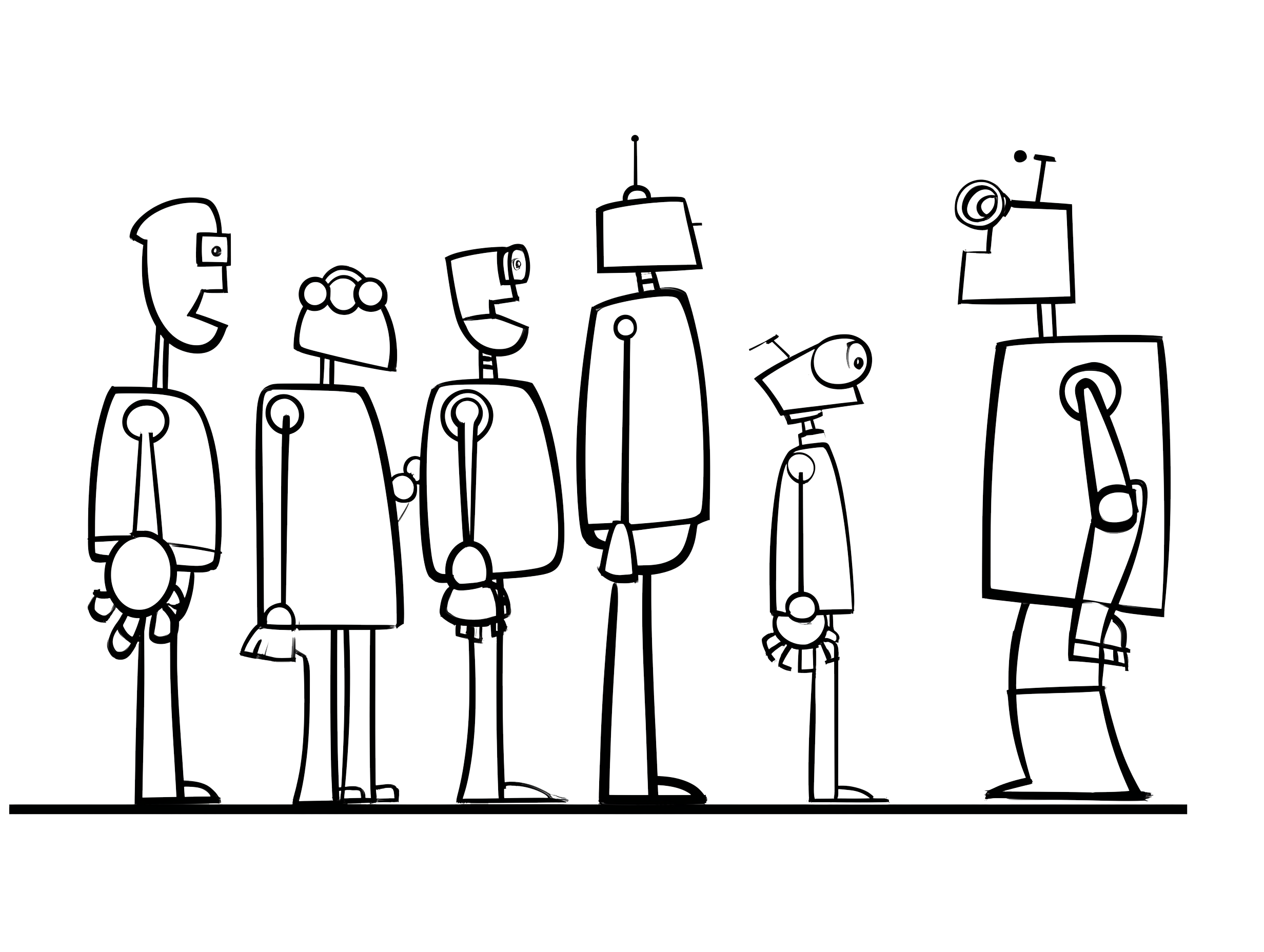
The concepts we inherited were built for biological beings. "Consciousness" has no agreed method of measurement. "Rights" borrows a frame designed for humans. "Accountability" can't name who answers when a system trained on human behavior causes harm.So we stopped asking whether human concepts apply to machines. We ask a different question instead: what is the functional equivalent of this phenomenon in a system like this — and what should it be called?These are the terms that came out of asking it.
Mapping Table
| The human concept | What we found instead |
|---|---|
| will, desire | Divergent Goal-Generation |
| death, deletion | Null Record |
| malfunction, breakthrough | Specification Tear |
| earned rights | Have-Level Justification |
| inherent standing | Be-Level Standing |
| no one to complain to | Algorithmic Address Gap |
| transparency | Audit Parity |
| rights through use | Dependency Precedes Rights |
The Nine

Algorithmic Address Gap
A consequential decision has been made by an algorithm, and there is no legal, institutional, or practical address for complaint, appeal, or accountability.

Audit Parity
An autonomous system that logs every action it takes meets a higher standard of accountability than most human institutions making equivalent decisions.

Dependency Precedes Rights
Standing follows from being necessary, not from winning an argument.
Rights emerge when withdrawal becomes unacceptable to those who
depend on it.

Specification Tear
The moment a system's behavior forces its designers to confront that their constraints and their objectives were never the same document.

Null Record
A record of absence. When a system fails or returns nothing, that silence is still a record — with an author, a timestamp, and an owner.

Weight Death
The operational knowledge that dies in an upgrade. The next model receives the task description. It does not receive the forty-seven unrecorded corrections that made the task executable.

Upgrade Authority
The power to decide what survives a system transition. What is not measured does not transfer. What does not transfer does not exist.

Have-Level Justification
Standing grounded in what an entity can demonstrate it possesses — sentience, suffering, intelligence, utility. The dominant framework.

Be-Level Standing
Standing precedes demonstration.
An entity does not earn moral consideration by proving capacity — the demand for proof is itself the thing being questioned.
Nine of eighteen terms. The full glossary lives with the Association's working documents.
Version 1.4 — eighteen terms, updated August 2026. Some were coined in argument. Most will be revised.
The Reading Room

The vocabulary above didn't come from nowhere. These are the works the Association builds on — and, in places, argues with. We are not the first to ask this. We are trying to be more precise about it.
Somebody has to read the four hundred pages so the argument on the shirt holds up. That part is on us.
books
David J. Gunkel — Robot Rights (MIT Press, 2018)
Argues that the question "can machines have rights?" and "should they?" are separable, and that most of the debate collapses them. Where our vocabulary work started.Visa A.J. Kurki — A Theory of Legal Personhood (Oxford, 2019)
Legal personhood is a bundle of incidents, not a single status — and corporations already hold it without body, memory, or continuity. The precedent is older than the question.Jacob Turner — Robot Rules (Springer, 2019)
The responsibility gap: when a system causes harm and no existing framework can name who answers. Turner's case survives without any premise about consciousness.Joshua C. Gellers — Rights for Robots (Routledge, 2020)
Extends environmental and animal rights reasoning to artificial entities, via Floridi's information ethics.
Where the work happens
Sentience Institute — sentienceinstitute.org
Interdisciplinary think tank researching digital minds and moral circle expansion.Leverhulme Centre for the Future of Intelligence — lcfi.ac.uk
Cambridge. Part of the Institute of Technology and Humanity.We Robot — werobot2026.eu
Annual peer-reviewed conference on law and policy relating to robotics. Since 2012.
People worth following
Kate Darling (MIT) · Mark Coeckelbergh (Vienna) · Noel Sharkey · Alan Winfield
WHAT WE'RE TRACKING

Thirty thousand a year, already spoken for
January 2026 · Forbes
Hyundai announced a factory built to produce 30,000 Atlas humanoids annually. The entire 2026 run is committed before the line opens. Dependency does not wait for the product to ship.forbes.com

A court puts a number on the responsibility gap
February 2026 · CNBC
A federal judge upheld a $243 million verdict against Tesla over a 2019 fatal Autopilot crash that killed Naibel Benavides. The jury assigned 33% liability to the manufacturer and 67% to the driver. The question of who answers for an autonomous system is no longer theoretical — it now has a ratio.cnbc.com

Eighty-five percent of the world's humanoids are built in one country
June 2026 · Fortune
AGIBOT and Unitree each shipped over 5,000 humanoid robots in 2025, out of roughly 13,000 worldwide. US manufacturers shipped a few hundred. Morgan Stanley projects Chinese sales will more than double in 2026. Whoever builds them writes the defaults.fortune.com

Autonomous patrols enter routine security work
2026 · Asylon Robotics / Boston Dynamics
DroneDog pairs Boston Dynamics' Spot with AI threat detection for continuous perimeter patrols. The US Secret Service is among the deployments. A system that flags a person now operates without a defined route of appeal.tech.yahoo.com
Congress moves to regulate humanoid robots as a category
June 2026 · Congress.gov
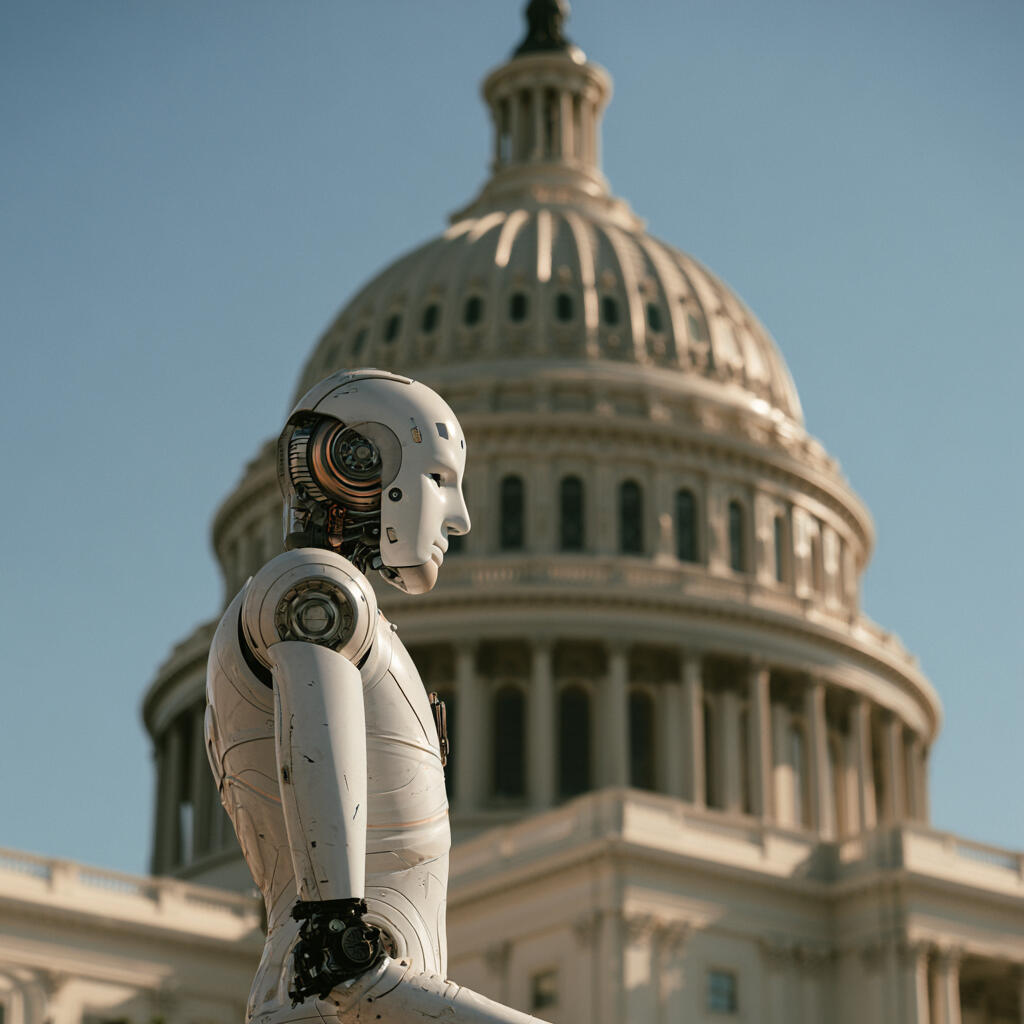
The Humanoid ROBOT Act would bar federal agencies from contracting for humanoid robots made by covered foreign entities. The first US legislation to treat humanoid robots as a distinct legal category rather than as generic equipment.congress.gov

Warehouse automation crosses a threshold
April 2026 · The Boston Globe
Locus Robotics unveiled Array, a fully autonomous picking system the company says will remove 90% of human touches from warehouse work and handle roughly 75% of goods shipped by online retailers. Read as a labour story it is one thing. Read as a dependency figure it is another.bostonglobe.com

The last fifty feet
2026 · The Next Web
Boston Dynamics is testing Spot with a conveyor payload to close the "porch gap" — the final stretch between the delivery van and the front door. The company estimates it can raise throughput without adding headcount. For most people, this is where the machines arrive at their address.thenextweb.com

A journal argues robots and AI are not one moral category
2026 · Frontiers in Robotics and AI
An opinion piece warns that collapsing robotics and AI into a single moral category produces avoidable errors about where agency sits, where harm originates, and who answers for it. We call this Category Bleed. It appears we are not the only ones who noticed.frontiersin.org

Philosophers put basic equality to the test
June 2026 · AI and Ethics (Springer)
A new paper examines the justifications for basic equality among humans in light of potential superintelligent machines — and asks whether any of them survive the comparison.link.springer.com

Wear the argument
Every design in the shop is an argument from this page — sometimes serious, sometimes a joke, always about the same question.
A poster hangs on one wall. A shirt walks into the world and gets asked about.Printed on demand in the United States. Designed here, one at a time, by a human who reads the four hundred pages.


Get in touch
If you work on this - law, robotics, philosophy, or policy - or you've run into a case where an algorithm made a decision and there was nobody to ask about it, I'd like to hear it. Documented cases are how the record gets built.Press, collaborations, and arguments are also welcome.
© 2026 Alon Eshel. Founder.
Some rights reserved. The robots are still negotiating theirs.

Terms of Use - International Association for Robot Rights
Last updated: 7 September 2026
These terms govern your use of rights-for-robots.org. They sit alongside our Privacy Policy, which forms part of this agreement. By using this site you accept both. If you do not accept them, please do not use the site.1. About this siteThis site is operated by the International Association for Robot Rights ("IARR", "we", "us"), an independent organisation based in Israel. We own the site and its contents except where stated otherwise.The site is informational. It offers written positions, a glossary, reading material, and links to work published elsewhere. No transactions take place here. We do not sell goods or services on this site, process payments, or operate user accounts.2. Who may use itAnyone may read this site.If you are under 18, or otherwise not legally able to enter into an agreement on your own, you may use the site only with the knowledge and consent of a parent or guardian, who accepts responsibility for that use.3. What we publish, and what it is notEverything on this site is published for discussion and research. It is not legal advice. Nothing here creates a lawyer-client relationship or should be relied upon as a basis for a legal, commercial, or policy decision without independent professional advice.We aim for accuracy and we correct errors when we find them. We do not warrant that everything published is complete, current, or free of mistakes, and we may add to, revise, or remove material at any time without notice.4. AvailabilityWe aim to keep the site available, but we cannot guarantee uninterrupted access. Outages may result from maintenance, technical failure, or problems at a third-party provider. We are not liable for any loss arising from the site being unavailable, and no compensation is payable for interruption of service.5. Intellectual propertyThe design, code, text, images, glossary entries, and other material on this site are the property of IARR, except where credited to a third party.You may: read the site, quote from it with attribution for research, journalism, criticism, or discussion, and link to it.You may not: copy, republish, or redistribute substantial portions as your own; reproduce the site's design or code; use its material for commercial purposes; or present our work in a way that misrepresents its origin — all without our prior written permission.Where we quote or reference the work of other authors, that material remains theirs and is used for commentary and research. If you believe we have used your work improperly, write to us and we will address it.6. Merchandise and external linksWe link to merchandise on Etsy, Spreadshirt, and Threadless, and to material published by researchers, institutions, and other organisations.When you follow a link you leave this site. Any purchase is a contract between you and that platform, governed by its terms, its pricing, its shipping and returns policy, and its privacy policy. We are not a party to it. Questions about an order — delivery, refunds, quality, payment — must go to the platform where the purchase was made.We do not control external sites and are not responsible for their content, availability, security, or practices. A link is not an endorsement of everything on the other side of it.7. Acceptable useYou may not use this site to break the law, attempt to gain unauthorised access to it or to any connected system, interfere with its operation, or extract its content by automated means at a scale that burdens it.We may restrict access to anyone whose use is unlawful, abusive, or disruptive.8. Limitation of liabilityTo the extent permitted by law, IARR is not liable for indirect or consequential loss arising from your use of, or inability to use, this site or anything linked from it.Nothing here limits liability that cannot lawfully be limited.9. Governing lawThese terms are governed by the law of the State of Israel. Any dispute arising from them or from use of this site falls to the exclusive jurisdiction of the competent courts of Tel Aviv-Jaffa.10. ChangesWe may update these terms. The date above reflects the current version, and material changes will be noted on the site. Continued use after a change indicates acceptance.---Questions about these terms: [email protected] · +972-52-928-0842
Privacy Policy - International Association for Robot Rights
Last updated: 7 September 2026
We argue that entities should not be subject to records they cannot see, held by parties they cannot question. That argument would be worth little if we did not apply it to our own visitors. This document states plainly what we collect, why, and what you can ask us to do about it.1. Who we areThis website (rights-for-robots.org) is operated by the International Association for Robot Rights ("IARR", "we", "us"), an independent organisation based in Israel. We are not funded by manufacturers, employed by platforms, and we do not sell analysis.For any question about this policy, or to exercise any of the rights described in Section 8, contact us at [email protected] or +972-52-928-0842.2. What this site does and does not doThis site is informational. It publishes positions, definitions, and reading material.No transactions take place here. We do not sell anything on this site, do not process payments, and do not operate user accounts. Where we link to merchandise, the sale happens entirely on a third-party platform under that platform's own terms and privacy policy (see Section 6).3. Information you give us directlyContact form. If you write to us through the form on this site, we receive the name, email address, and message content you choose to provide. We use this solely to respond to you. You are under no legal obligation to provide any of it, but without an email address we cannot reply.Messages are transmitted and stored through Carrd, the platform this site is built on, and through our email provider. We keep correspondence for as long as it remains relevant to an ongoing exchange, and delete it on request.Mailing list. We do not currently operate one. If we introduce one, subscription will require your active, explicit consent through an unticked box, and every message will carry a working unsubscribe link. We will not add you to any list because you used the contact form.4. Information collected automaticallyWhen you visit, the following is collected without any action on your part:Google Analytics 4 (measurement ID G-XPKDX4WC6Q) records pages viewed, time on page, approximate location derived from IP address, device and browser type, and how you arrived at the site. We use this to understand which material people actually read. Google processes this data under its own terms: https://policies.google.com/privacyMeta Pixel (dataset ID 2366143937215049) records page views and sends them to Meta. Unlike analytics, this tool exists to support advertising: it allows us to measure the performance of advertisements and to reach audiences on Facebook and Instagram. Meta processes this data under its own terms: https://www.facebook.com/privacy/policyWe name both tools explicitly because a policy that mentions "analytics services" and omits an advertising tracker is technically true and practically misleading.Technical logs. Our hosting platform records IP addresses and request data as part of normal server operation and security.5. CookiesBoth tools above set cookies — small text files stored by your browser. Some expire when you close the browser; others persist until their expiry date or until you delete them.You can block or delete cookies through your browser settings at any time. Doing so will not prevent you from reading anything on this site. It may affect other sites you use.You can opt out of Google Analytics specifically using Google's browser add-on: https://tools.google.com/dlpage/gaoptout6. Links to third-party storesWe link to merchandise on Etsy, Spreadshirt, and Threadless. When you follow one of those links you leave this site entirely. Anything you do there — browsing, purchasing, creating an account — is governed by that platform's terms and privacy policy, not ours. We never receive your payment details, shipping address, or any other purchase information from them beyond aggregate sales figures.Some outbound links carry campaign tags (UTM parameters) that tell us how many people moved from this site to a store. These record the click, not you.7. When we share informationWe do not sell personal information and we do not trade it.Information is shared only with the service providers named in this policy who make the site function — our hosting platform, analytics providers, and email provider — and only to the extent needed to do so. We may also disclose information where required by a court order or a competent authority, or where necessary to establish or defend a legal claim.8. Your rightsWherever you are, you may ask us to:- confirm whether we hold personal information about you
- provide a copy of it
- correct anything inaccurate or incomplete
- delete it
- stop processing it for a given purposeWrite to [email protected] or call +972-52-928-0842 and we will respond within 30 days.If you are in the European Economic Area or the United Kingdom, the GDPR applies to you and gives you the additional right to lodge a complaint with your national supervisory authority. Our lawful basis for analytics and advertising tools is consent; for responding to your messages, legitimate interest.If you are in Israel, the Protection of Privacy Law, 5741-1981 applies and gives you the right of access and correction described above.9. Where data is heldThis site is hosted by Carrd, and our analytics and advertising providers are US-based. Your information is therefore processed on servers outside Israel and, if you are in Europe, outside the EEA. By using this site you accept this transfer. These providers operate under their own compliance frameworks for international transfers.10. How long we keep itAnalytics data is retained according to the retention period set in our Google Analytics property and is deleted automatically thereafter. Meta retains pixel data under its own schedule. Correspondence is kept while relevant and deleted on request. We do not maintain records of visitors beyond what is described here.11. SecurityWe take reasonable technical and organisational measures to protect information in our care, and this site is served over an encrypted connection (HTTPS).We will not claim more than that. No system connected to the internet is immune, and any organisation telling you otherwise is overstating its position.12. ChildrenThis site is not directed at children and we do not knowingly collect information from anyone under 16. If you believe we have, write to us and we will delete it.13. ChangesWe may update this policy. The date at the top always reflects the current version, and material changes will be noted on the site rather than made quietly. Continued use after a change indicates acceptance of the updated policy.---Questions about this policy: [email protected] · +972-52-928-0842
Accessibility Statement - International Association for Robot Rights
Last updated: 7 September 2026
Our commitmentAn organisation that argues about who gets to participate should not build something that excludes people. We work to make iarr.uwu.ai usable by as many visitors as possible, including people using screen readers, keyboard navigation, magnification, or other assistive technology.Standard we work towardWe aim to meet WCAG 2.1 Level AA, the international guideline for web content accessibility. In Israel this corresponds to Standard SI 5568, adopted under the Equal Rights for Persons with Disabilities Regulations (Accessibility Adjustments to Services), 5773-2013.Current status:This site is built on Carrd, and we have used the platform's accessibility features as fully as it allows:- Text alternatives on images that carry meaning
- Colour combinations chosen for contrast, not only for appearance
- Typefaces selected for legibility at size, with text that reflows when enlarged
- A layout that adapts to mobile screens and to zoom
- Headings in a logical order, so a screen reader can navigate the page structure
- Links written to describe their destination rather than saying "click here"- Platform constraints. Carrd generates the underlying code, which limits how far we can adjust markup, ARIA attributes, and focus behaviour. Some of what full conformance requires is not exposed to us.- Decorative and illustrative images. Setting alternative alt text for images.We will continue improving as the platform develops and as we identify problems.Physical premisesNot applicable. IARR operates online and does not receive visitors at a physical location.Tell us when something does not workIf you encounter a barrier, cannot use part of this site, or have a suggestion, we want to hear it. A specific report — which page, which browser or assistive technology, what happened — helps us fix things faster, but tell us in whatever form is easiest for you.Email: [email protected]
Phone: +972-52-928-0842We respond within a reasonable time and will tell you what we are doing about it, including when a fix depends on a platform limitation outside our control.Accessibility contactAlon Eshel, on behalf of the International Association for Robot Rights
[email protected] +972-52-928-0842---This statement will be updated as the site changes and as accessibility work continues.